The startup ecosystem is genuinely getting better, especially here in Uzbekistan.
People of all ages, from 12 to 60, are building pieces of tech that can actually help someone, somewhere. And that is exciting to see.
But one thing I want to see more of, in every startup enthusiast out there (myself included), is building for the sake of it. Like building things because a problem is annoying to you and you want it gone.
What do I mean by that?
If you were to look at how the biggest companies actually started, a quiet pattern emerges. The founders were directly suffering from the problem themselves. They never started by sitting in a room trying to invent a unicorn. They just found something personally annoying and wanted it fixed.
First, the founders were victims of the problem themselves. Second, they were simply the best at what they did.
Either way, none of them started with "That's it! Imma build a billion dollar company." they started with a problem that was annoying them personally, and they wanted it solved. And the billion dollar part came later... almost accidentally.
The clearest example I know is Linus Torvalds: In 1991, Linus was a 21-year-old computer science student in Finland who just wanted a free operating system he could actually use and modify. He was not trying to take on Microsoft. He was not pitching investors. He just posted a message on a forum that basically said: "I'm making an OS. It's just a hobby. Nothing big or professional." That hobby became Linux. Today it runs most of the internet, powers Android, and sits at the core of systems used by millions, if not billions, of people. He solved his own problem, in public, and the world showed up.
And then he did it again.
By 2005, Linux had grown massive. Thousands of developers contributing code from all over the world. The tool they were using to manage all that code stopped working, and nothing out there did what they needed. So Linus sat down and, in roughly ten days, built a version control system for himself and his team, which he would later call it Git
"Git was my second big project which was only created for me to maintain my first big project"
— Linus Torvalds
Today nearly every software project on the planet uses Git. GitHub, built entirely around it, was acquired by Microsoft for $7.5 billion. Linus did not build Git to get rich. He had a problem and he needed it solved.
You see, it's not about chasing scale, but it's about understanding a problem so deeply, living inside it so closely, that your solution carries a specific weight that someone building from the outside simply can't replicate. You see the edges others miss. You feel the friction others have learned to ignore. You can feel when it is actually right.
Last month, I had emailed Paul Graham asking what he would recommend for a 17-year-old to do, and I briefly explained about myself and what I was building. I was not honestly expecting a reply. But he replied. His answer was roughly this:
"Work on your own projects. Do not require the project to be a potential startup. That is too constraining. Just build something that would look cool to build."
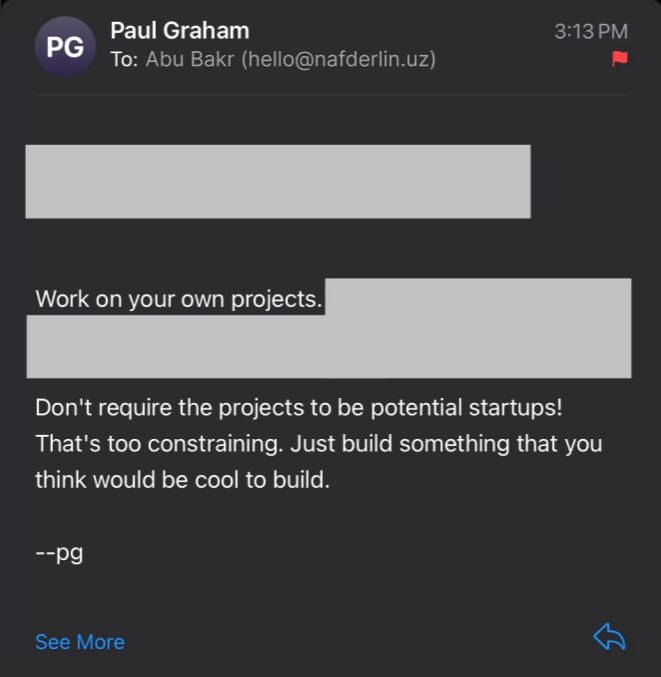
That last line really got stuck with me: "*Build something that would look cool to build*"
So, the verdict is simple: find the problem you actually face. Understand it deeply. Then try to solve it. Those two things together, personal pain and genuine understanding, tend to produce something real.
Keep building... and maybe one day, without even planning for it, you'll accidentally make something the world can't stop using.